
Zeno’s Tortoise and the AI That Says ‘I’
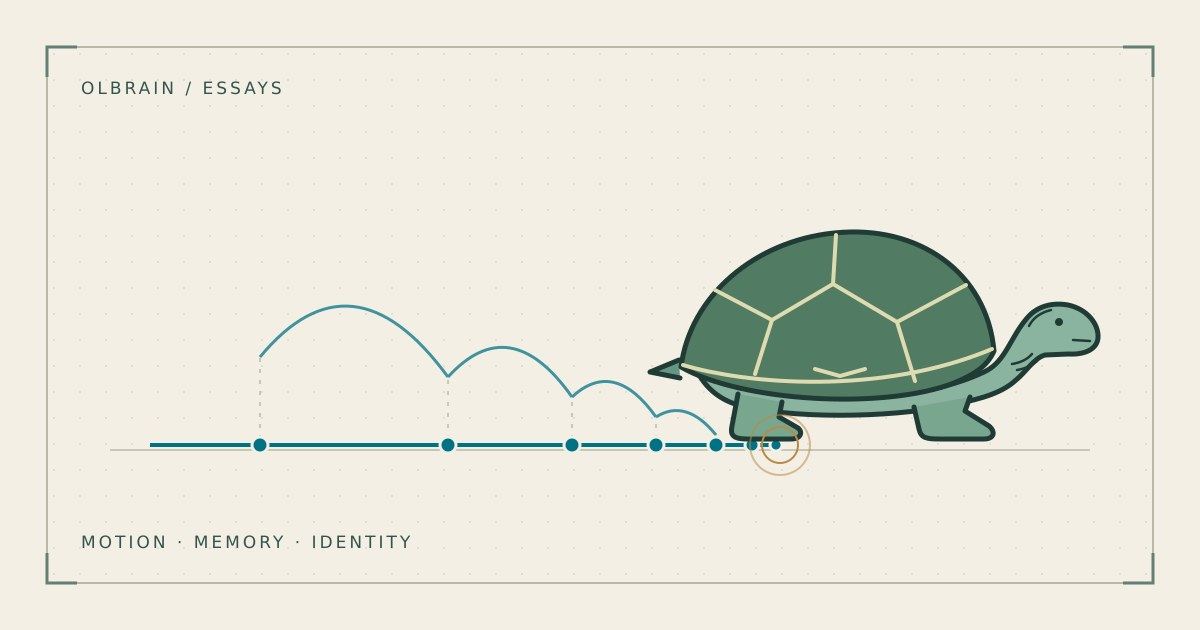
I was thinking about Zeno’s tortoise when it struck me that I’d been asking a similar question about AI agents. I can ask an agent a question, leave, come back, and ask another. The first model call has ended. The next one is a new computation. Yet when it says “I,” I hear the same speaker. What, exactly, makes it the same?
Is the race really made of those steps?
Zeno gives a tortoise a head start against Achilles. By the time Achilles reaches the tortoise’s starting point, it has moved farther along. By the time he reaches that next point, it has moved again. There’s always another, smaller gap to close. On that description, it sounds as if Achilles can never catch up.
The mathematical answer is that infinitely many intervals needn’t take infinitely long. If they take half a second, then a quarter, then an eighth, and so on, the total is one second. Achilles catches the tortoise at that limit and overtakes it after. The paradox as stated doesn’t show that continuous motion is impossible.
Carlo Rovelli asks a different question in chapter 6 of Reality Is Not What It Seems: is the limitless divisibility in the mathematics also a property of the world? In loop quantum gravity, quantities such as area and volume have discrete quantum values. Rovelli pictures Achilles closing the last gap in a quantum leap. That’s an illustration of a theory, not an experimental demonstration that a runner moves in tiny jumps.
What stayed with me was the reversal. I’d assumed the motion was continuous and the steps were something we drew on top of it. Rovelli invites us to consider the other possibility: the underlying structure may be granular even when the world we experience looks smooth.
What survives when the model stops?
Imagine an agent tells me on Monday, “I’ll ask you to approve the revised forecast before I send it.” On Tuesday, the model that generated Monday’s answer isn’t still thinking about it. A fresh call can nevertheless pick up the task. But it matters what it picks up. A transcript may let it repeat the promise. A record of the pending approval lets the system act on that promise by withholding the send until I approve it.
That’s where I’d look for the continuity: in the state and commitments that carry over and constrain the next action. The new call can use a different model and still belong to the same operating agent. Conversely, two copies can start with the same transcript and both say “I remember promising that.” If they then act independently, the transcript alone can’t tell me which one has the authority to send the forecast.
This is a practical design question for us at Olbrain. If someone asks which agent made a change, what it was allowed to do, and what it still owes them, the answer can’t depend on how convincingly a model uses the word “I.” We need an identity the system can refer to, a record of what happened, and rules for who can act under that identity. That distinction is part of what we explore in the CNE-Protocol.
And what about my own “I”?
Here I have to be more careful. I don’t know that human experience is made of discrete episodes in the same way a conversation with a language model is made of separate calls. Rovelli’s argument about space tells us nothing by itself about the structure of consciousness.
But I can still ask the parallel question. I remember making a promise years ago and regard it as mine today. Does that require something inside me that has stayed the same the whole time? Or am I calling the living process that carries the memory and the obligation forward “me”?
I find the second possibility compelling. It lets continuity be real without making the self an unchanging object. But it leaves the part I find hardest to explain: why does carrying that past forward feel like I lived it? I can design an agent that keeps a promise after its model call ends. I can’t infer from that achievement that there’s anyone inside who remembers making it.