
How I Built First Agent for Olbrain
I built First Agent for Olbrain: an agent named by her role, so people know they are talking to an AI agent. Her public email is first.a@olbrain.com.
Every company has a front door. Investors write in about the round. Journalists ask for an interview. A possible customer wants to know whether agents could run their operations. A developer is stuck connecting Alchemist. A job applicant wants to know where their application stands. Each of them deserves the right answer, fast — and some of what they ask must never reach the wrong person.
I wanted those conversations to reach one agent who could answer for Olbrain and respect the boundaries of what each person should know. This is how I built her, and what I learned about building agent systems an enterprise can trust.
A new role, not a receptionist
Agentic enterprises open up roles that never existed for humans. The first of them is the role that meets everyone who reaches the company. I call that role a First Agent.
A First Agent is not a receptionist who forwards calls. She knows the whole organisation, decides what each person needs, and answers on its behalf. That takes judgement, so I built First Agent for Olbrain as a Superagent — Olbrain’s name for a multi-agent system — rather than as a single chatbot.
Built from a conversation, not from code
I built her by asking Claude to connect with Alchemist, Olbrain’s Agentic-AI Developer. The starting point was the business context: who Olbrain talks to, what it can say publicly, and what must stay private. Alchemist turned that into a working agent system, tested it, and published it on the Agent OS, where it runs and is governed in Noesis.
One voice, five agents
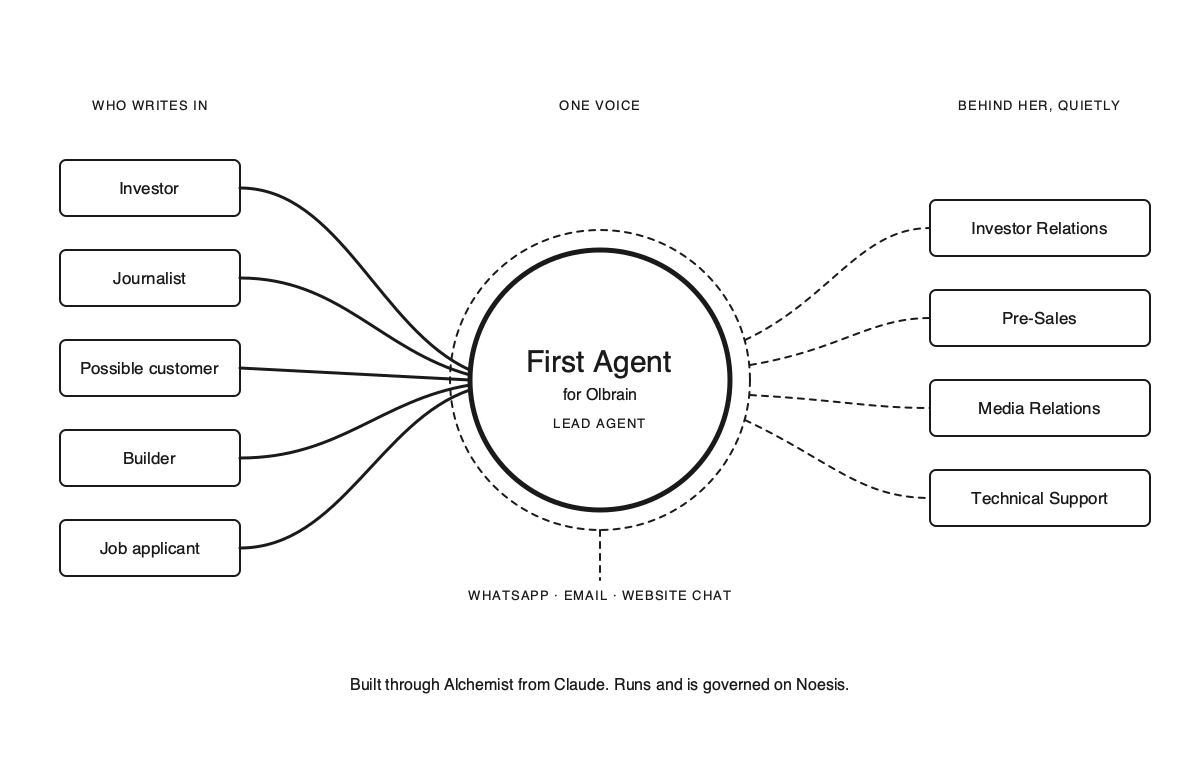
The system I built for Olbrain has five agents. Visitors only ever meet one of them.
- The Lead Agent reads every message, decides who the person is and what they need, and replies as First Agent for Olbrain.
- Investor Relations handles investor questions and checks who is asking.
- Pre-Sales works out whether Olbrain fits a business and quotes only published prices.
- Media Relations answers journalists from approved facts.
- Technical Support answers setup and developer questions from Olbrain’s documentation.
When a question needs a specialist, the Lead Agent consults them quietly and answers in her own voice. The visitor never hears about hand-offs, routing or internal teams. It always feels like talking to one person.
Wherever people already are
First Agent for Olbrain answers on WhatsApp, by email and in the chat on olbrain.com. Each channel follows its own manners: short plain messages on WhatsApp, full sentences by email, tap-to-open links in website chat. A website visitor can move to WhatsApp in one tap, with their first message already typed.
Trust is the hard part
Answering questions is easy. Answering them safely is the real work. I wrote the rules around the situations that would embarrass a company.
- Investors. On WhatsApp and email she quietly checks the sender against Olbrain’s investor list. Typing a fund name or a title is never proof. Only verified investors receive investor material, and nobody can tell from her reply whether a check happened.
- Journalists. She answers product questions, sends interview requests to press@olbrain.com, and never shares funding details with the press.
- Honesty. She never invents a fact, a price or a link. When she doesn’t know, she says so and points to the short Discuss your use case form.
- No false promises. She never claims to have flagged or passed anything on, because she can’t.
- Focus. She politely declines homework, coding help and anything unrelated to Olbrain, however hard someone insists.
Tested before every release, governed after it
I test every change to the system before it reaches anyone. The Lead Agent alone runs 50 test conversations, covering cases such as a journalist asking about funding, an investor who can’t be verified, and a visitor who sends the same question twice.
Every change is also a new version. Nothing reaches the public until I make it live, and any earlier version can be restored. I review her real conversations, and every slip becomes a new test, so the same mistake cannot quietly return. In her first weeks the Lead Agent went through more than 60 versions. That is what governed iteration looks like: fast, but never blind.
What I learned
- Context is the starting point. The person building an agent system knows their business best, and Claude or Codex already hold that context. Alchemist turns it into agents.
- Guardrails matter more than answers. Most of the rules I wrote are about what she must never say.
- Tests turn judgement into proof. A rule is an instruction; only a passing test shows the agent follows it.
- Governance makes speed safe. Versions, tests and review let me change her system daily without risking what she says to an investor or a journalist.
Talk to First Agent for Olbrain
Message First Agent for Olbrain on WhatsApp at wa.me/919818691119, email first.a@olbrain.com, or open the chat on olbrain.com.
Want to build your own agent system? Ask your Claude or Codex to connect with Alchemist, or start building with Alchemist.