Why Memory Is Not Identity
The most common pushback I get when I talk about agency for AI agents is this:
“Memory has been solved. Agents can remember conversations now. What more do you need?”
It’s a fair question. Here’s the answer.
What Memory Actually Is
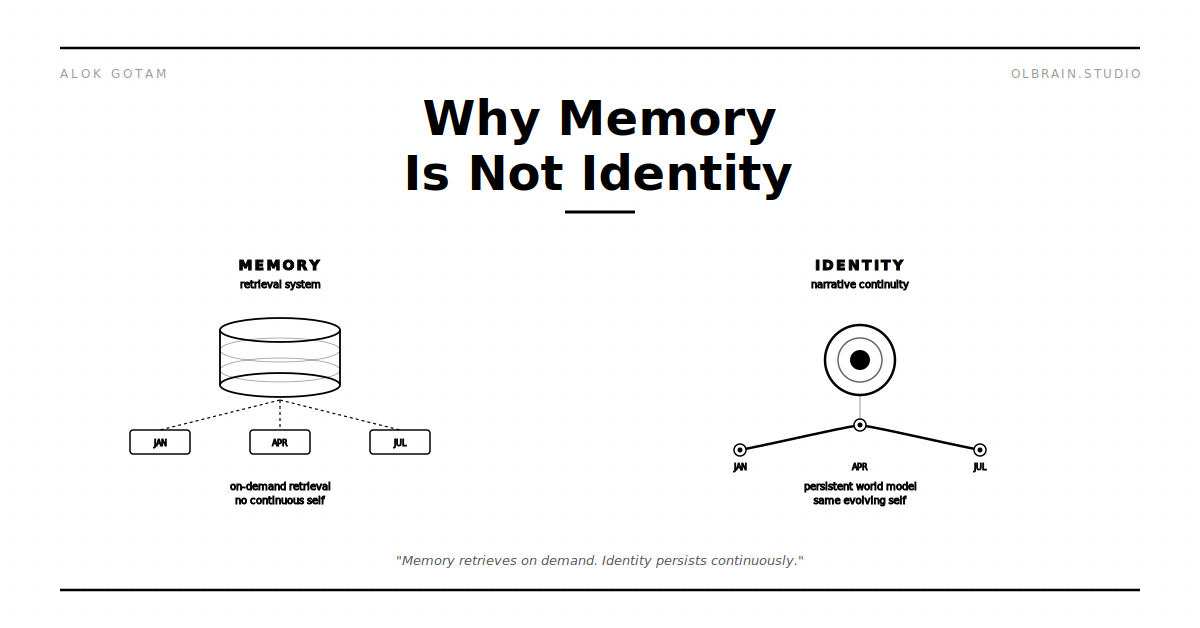
Memory in current AI agents is a retrieval system. The agent stores past interactions in a database, and when relevant, retrieves them and stuffs them into the prompt. The LLM reads this context and generates a response.
This works well for many things. The agent can correctly say “you mentioned last month that you prefer blue.” The fact was stored. It was retrieved. It was used.
But this is data retrieval. Identity is something architecturally different.
What Identity Adds
Identity is narrative continuity — a structured world model that carries forward across every interaction, every channel, every month. Not a chat log that gets retrieved. A persistent representation that makes the agent recognisably the same entity today as it was six months ago.
The architectural difference is concrete:
A memory system retrieves stored data on demand. Each retrieval is a separate event — pull the relevant chat history, load it into context, generate a response. The “agent” the customer talks to in January and the “agent” they talk to in July are referencing the same database, but there’s no continuous representation tying those interactions into a single evolving self.
An identity system maintains a singular world model that updates with every interaction. The model evolves — it doesn’t just accumulate. When the customer returns after months, they’re not talking to a fresh instance loading their history. They’re talking to the same continuous entity whose understanding of them has been growing the entire time.
That’s narrative continuity. The thread that makes “this agent” the same agent across time.
The Engineering Test
Here’s a concrete way to distinguish memory from identity:
Take any AI agent claiming “memory.” Have it form an understanding of a customer over five interactions in January. Then return in July. Don’t load any chat history into the context. Just start a new conversation.
A memory system: blank slate. Without retrieval, there’s nothing. The agent doesn’t know who you are.
An identity system: continuity intact. The world model has been the same persistent representation throughout. The agent recognises you not because it just retrieved a file, but because its understanding of you has been continuously held.
This isn’t a feature you bolt onto memory. It’s a different architectural layer.
Why This Matters Commercially
Identity sounds abstract until you ask one question: who is accountable?
When an agent makes a commitment to a customer — “your delivery will arrive Tuesday in a small vehicle” — who owns that commitment? In a memory-only system, the commitment is a line in a chat log. There’s no continuous entity that the commitment belongs to. It can be retrieved by one instance and missed by another.
In an identity system, the commitment lives inside the world model — a singular, continuous representation that can be traced. The customer who made the request and the agent who took it on are linked by a persistent thread, not a database query.
Accountability is the commercial outcome of identity. Trust is the commercial outcome of accountability. And trust is what unlocks the relationship market — wealth management, premium commerce, healthcare, insurance, education — where the durable value lives.
Businesses don’t buy identity. They buy the ability to trust their agent with more. Identity is the architecture that makes that trust possible.
The Bottom Line
Memory is a retrieval system. Identity is narrative continuity — a persistent world model that makes the agent the same evolving entity across time.
Memory has improved enormously and the work is genuinely impressive. But it’s a different layer than identity. You can’t get to identity by improving memory — any more than you can get to a database by improving file storage. They’re different architectural primitives.
The industry has built extraordinary memory. The next frontier is building the continuous self that uses it.