We Are MAD
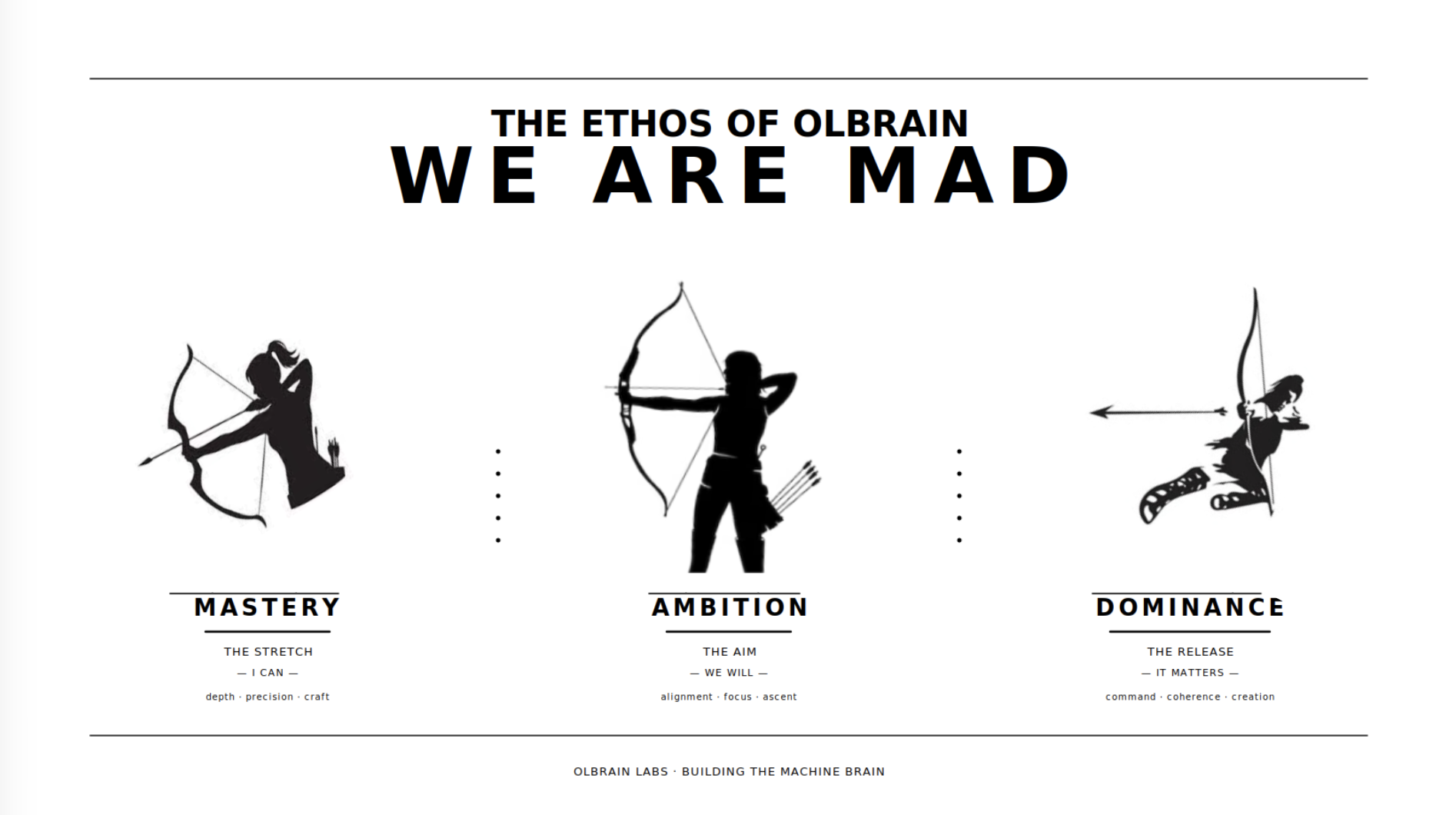
On the ethos that builds Olbrain — and the kind of people who belong inside it
Most companies talk about culture the way they talk about office snacks: as a perk, a backdrop, a thing that exists somewhere between the wall art and the all-hands deck. At Olbrain, culture is not the backdrop. It is the work.
Let me be precise about what we are building, because precision matters here.
We are not building intelligence. That is the work of foundation model companies — and they are doing it brilliantly. LLMs already think. They reason, they synthesise, they generate. The cognitive layer of the future is essentially solved.
What is not solved is agency.
Intelligence without agency is a parlor trick. A model can answer any question you put to it, then forget you exist the moment the conversation ends. It has no continuity, no identity, no sense of self that persists across time. It does not belong to its own actions. It is, in the truest sense, no one.
Olbrain exists to fix that. We are building the agency layer — the protocol that gives an AI agent persistent identity, narrative continuity, and exclusivity. The thing that makes an agent into a someone rather than a something.
That is not a small mission. It is not an obvious mission. And it cannot be built by ordinary people in ordinary ways.
It demands a particular kind of person, held together by a particular kind of ethos.
We call ours MAD.
Mastery. Ambition. Dominance.
Three words that sound, on the surface, like the language of conquest. They are not. They are the language of creation — the inner architecture of anyone who has ever built something that did not exist before.
Let me explain what each one actually means here, because the words are easy to misread.
Mastery — The Depth of Precision
Mastery is the inward force. The descent.
It is what happens when you refuse to leave a problem alone until the chaos in it resolves into a pattern. It is the discipline of staying with a question longer than is comfortable, longer than is reasonable, longer than your peers. It is the quiet refusal to accept “good enough” as a stopping point.
Where most people see noise, the master sees an unfinished equation.
Mastery is how confidence is born. Not the loud kind — the brittle confidence of borrowed certainty — but the quiet, unshakeable kind that comes from having actually done the thing. The kind that says, simply: I can.
At Olbrain, mastery means ownership of craft. Our engineers, our designers, our thinkers don’t just know how something works. They know why it must work that way — and why every other way is wrong. They have descended into the complexity. They have done the time.
This matters because we are building infrastructure for a problem most of the industry hasn’t even named yet. Agency is not in the textbook. The protocols that would give an AI agent a persistent self are not waiting on Stack Overflow. There is no manual for what we are doing. There is barely a vocabulary.
Mastery is the only way through.
If you are someone who, when handed a problem, finds yourself unable to put it down until you have taken it apart and rebuilt it in your own hands — you already speak this language.
Ambition — The Bridge in Motion
Mastery, alone, can become a cage. The expert who knows everything and ships nothing. The craftsman who polishes a single object for a lifetime while the world moves past.
This is why mastery, by itself, is not enough.
Ambition is the bridge. It is the kinetic force that takes depth and turns it into motion, knowledge into impact, understanding into creation. It is gravity, inverted. It does not weigh you down. It pulls you upward.
Ambition, at Olbrain, is not greed. Greed is the appetite for what already exists — money, status, possessions someone else has already built. Ambition is the appetite for what does not yet exist. The thing only you can see. The thing that lives, for now, only as a shape in your head.
Ambition is the voice that says: We will.
Notice the we. This is important. Personal ambition is common — it is the engine of most careers. Collective ambition is rare. It is the engine of movements.
At Olbrain, every act of mastery is meant to feed something larger than the individual who performed it. The breakthrough you have on a Tuesday afternoon is not your trophy. It is fuel for the collective ascent. The agency layer we are building is not a thing any one person could build alone — it is something we are building together, into the world.
If the idea of folding your individual brilliance into a collective ascent excites you more than the idea of being the smartest person in a room — you already speak this language too.
Dominance — The Zenith of Creation
This is the word people misread most often. So let me be precise.
Dominance, at Olbrain, has nothing to do with power over people. We are not interested in hierarchies of ego. We are not interested in being the loudest voice in any room. The world has enough of that.
Dominance, here, means command over complexity. The capacity to take chaos and organise it into coherence. To take a tangle of possibilities and shape them into a structure that holds. It is the moment your craft becomes command — when the thing you have built starts behaving like an inevitability rather than an experiment.
It is what gives the work its significance. The simple, undeniable sense that it matters.
There is a deeper layer here, worth naming. Neurobiologically, dominance is the purest expression of the dopaminergic drive — the human urge to extend mastery into the world, to convert potential into structure. It is not the lust for control. It is the craving for creation.
This is a subtle but enormous distinction.
Dopamine, the molecule we mistakenly associate with reward, is not actually about having. It is about pursuing. It does not fire when you possess something. It fires when you reach for something. The endless drive to make the possible real — that is dopamine in its purest form. That is the human brain doing what it was built to do.
In Olbrain’s architecture, dominance is that same biological principle, rendered in code. It is what gives an agent the capacity to act with intent, to hold its own narrative across time, to remain itself in the face of every new context. Agency, when it works, is dominance — quiet, persistent, undeniable.
And here is the part most people miss: dominance is not conquest. It is consequence.
When mastery has matured and ambition has aligned, dominance is simply what follows. You do not chase it. You earn it, almost without noticing, because the work itself has become undeniable.
Why MAD — and what it is not
Now for the most important part. We need to be honest about what MAD is, and what it is not. Because if we get this wrong, we will attract the wrong people — and they will be miserable here, and we will be miserable with them.
A fulfilling human life, as I have come to understand it, runs on three drives: Happiness, Highness, and Holiness.
Happiness is the warmth of deep social connection — your family, your tribe, the people who love you for reasons that have nothing to do with what you produce. Holiness is the inner peace that comes from spiritual coherence — the quiet root system underneath everything else. Highness is the dopaminergic charge of professional achievement — the rush of having built something the world did not have before you arrived.
All three are real. All three are necessary. And the people who live the fullest lives are the ones who have all three sorted, in the proportions that work for them.
Here is the part most companies refuse to say out loud:
Olbrain is a Highness gym.
That is what we are. That is all we are. We are not your family. We are not your spiritual sangha. We will not heal what is broken in your relationships, and we will not give you the inner peace you have not built for yourself elsewhere. We do not pretend otherwise.
What we will give you is the rarest thing in a working life: a place where the dopaminergic drive of creation has nowhere to hide. A place where mastery is the price of admission, ambition is the air, and dominance — command over complexity — is the daily reward. A place where the work is hard enough, and the mission is large enough, that your craving for more finally has somewhere to go.
This is why we want people who have already sorted their Happiness and their Holiness elsewhere.
If you arrive here lonely, hoping the team will become the family you do not have — you will be disappointed, and you will distort the team trying to make it become one. If you arrive here spiritually hollow, hoping the mission will fill the void where your inner peace should be — you will burn out the moment the mission gets hard, because the mission was never meant to do that work.
But if you arrive here with Happiness and Holiness already in place — if you are loved at home, at peace within yourself, and you walk into Olbrain with both of those needs already met — then something extraordinary becomes possible. You are free. You can give the work everything, because nothing else is hungry. You can chase Highness without the chase becoming a cry for help.
That is who we want.
People who have done the inner work. People who have built the lives outside this office that let them show up here whole. People who come to Olbrain not because they need it, but because they choose it — because the dopaminergic pull of building the agency layer for the AI civilisation is, for them, the most exciting game in the world.
We chose the acronym MAD deliberately. The world’s largest leaps forward have always been made by people the world first called mad. The ones who took depth too seriously, who wanted too much, who refused to accept the limits everyone else had quietly agreed to live within.
LLMs gave machines the ability to think. We are giving them the ability to be. That is not a small ambition. It is, by any reasonable measure, a mad one.
Which is exactly why it requires this ethos — and exactly why it requires people who have come here for the right reason.
If you are reading this and something in you is leaning forward — not because the words are clever, but because they describe something you already recognise in yourself — then you already understand what we are building, and you already understand the deal.
Come and gang up with us for Highness.
We are MAD. And so are you.
That is how we are building Olbrain.
If MAD resonated with you and you want to understand the deeper philosophy behind “Highness, Happiness, and Holiness,” read The Quest for a Good Life — Life 3H Framework. It is the founder’s personal origin story behind the Olbrain ethos.