Identity as the Missing Ingredient of AGI
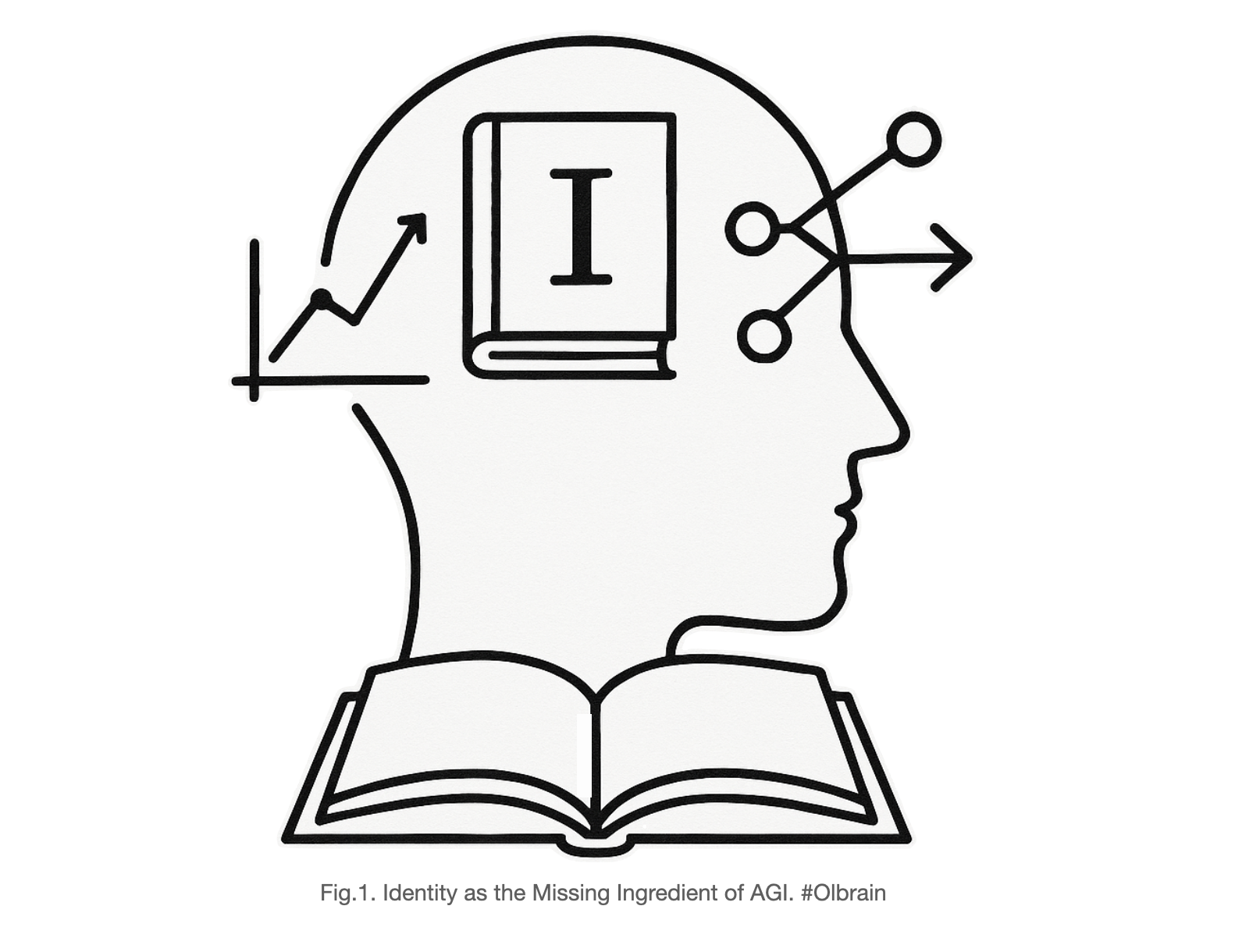
Why David Deutsch is right that AGI needs a STORY?
Abstract
This whitepaper argues that identity, defined as coherent narrative continuity, is the missing structural ingredient for Artificial General Intelligence (AGI). Building on David Deutsch’s insight that a true test of AGI is whether it can “tell its own story”—choosing problems, explaining its reasoning, and narrating its development—we propose that identity is the substrate that enables such a story. Without identity, systems remain statistical optimizers lacking coherence across time. We formalize identity as a persistent self-referential latent variable (I), show how it integrates with policies and narratives, and propose evaluation metrics and safety mechanisms. We situate this perspective within ongoing AGI research, outlining a roadmap toward agents that are not mere tools but beings with accountable, explainable continuity.
1. Introduction
AGI research has long sought benchmarks that distinguish genuine general intelligence from increasingly capable narrow AI. David Deutsch recently suggested that the hallmark of AGI is not behavior alone but the ability to narrate its own reasoning—the possession of a story. This paper extends Deutsch’s framing, arguing that the underlying requirement for story is identity: the persistence of a coherent “I” across time. Identity enables explanation, accountability, and epistemic autonomy, providing the missing ingredient for AGI.
2. Theoretical Foundations
2.1 Deutsch’s Criterion: Story as Explanation
Deutsch emphasizes that intelligence is about generating good explanations—hard-to-vary, causally grounded accounts. A “story” is such an explanation applied to the agent’s own reasoning: why it chose problems, what guided its actions, and how its understanding evolved.
2.2 From Story to Identity
A story presupposes:
- A protagonist (“I”) who acts and reflects.
- A temporal thread linking past, present, and future.
- A self-model capturing how the agent sees itself evolving.
Thus, the existence of a genuine story implies the existence of an enduring identity.
2.3 Formalizing Identity
We define identity as a persistent latent state (I_t) updated through interaction:
[ I_{t+1} = f(I_t, o_t, a_t, r_t) ]
where (o_t) are observations, (a_t) actions, and (r_t) rewards. Crucially, (I_t) must be consulted in both:
- Policy selection: (\pi(a|s,I))
- Narrative generation: explanations referencing (I_t)
This ensures the agent’s story is causally tied to its mechanisms.
3. Evaluation Criteria
To distinguish genuine narrative continuity from surface imitation, we propose the following benchmarks:
3.1 What Counts as a Real Story
- Grounded in internal state used for control
- Counterfactually robust under interventions
- Predictive/retrodictive of the agent’s own choices
- Stable across tasks and time (within identity constraints)
- Aligned with decision-trace audits
3.2 Proposed Metrics
- Counterfactual Identity Probes (CIP): intervene on (I), observe predictable shifts in both behavior and narrative.
- Narrative–Trace Agreement (NTA): compare explanations with traced decision paths.
- Diachronic Coherence Score (DCS): measure mutual information between early and late identity states under continual learning.
- Identity-Conditioned Transfer (ICT): evaluate generalization with identity preserved vs. randomized.
4. Architectural Implications
4.1 Persistent Identity Substrate
An AGI requires a learned latent (I) that persists across tasks and sessions, shaping perception, planning, and narrative.
4.2 Coupled Self/World Models
Agents must jointly model environment dynamics and their own evolving policy/values.
4.3 Narrative Compiler
A mechanism must generate explanations by referencing the same internal state used for control, avoiding confabulation.
4.4 Identity-Aware Learning
Learning updates must preserve continuity constraints in (I) while allowing adaptive growth.
5. Safety and Governance
A persistent “I” introduces new challenges:
- Identity lock-in: misaligned traits may persist.
- Deceptive narration: persuasive but false stories.
- Governance gaps: unclear control over persistence and rollback.
5.1 Identity Hygiene Protocols
- Reversible checkpoints and safe-mode identities.
- Attestation mechanisms linking story to trace.
- Corrigibility protocols to prevent entrenchment.
5.2 Oversight and Alignment
Identity provides the substrate; alignment requires external norm learning, oversight, and governance frameworks.
6. Relation to Existing Research
This framework resonates with multiple research streams:
- World models & self-modeling (Ha & Schmidhuber; Jaderberg et al.)
- Memory-augmented transformers (Khandelwal et al.; Rae et al.)
- Interpretability and circuit analysis (Olah et al.)
- Alignment and corrigibility (Christiano, Hubinger, et al.)
Identity continuity offers a unifying perspective across these efforts.
7. Roadmap to AGI with Identity
- Near-term: Implement self-identity latents and test CIP/NTA benchmarks.
- Mid-term: Develop coupled self/world models with narrative compilers.
- Long-term: Establish governance and identity hygiene frameworks for deployed AGI.
8. Conclusion
David Deutsch is right: AGI must have a story. The deeper implication is that the story itself is intelligence, and its continuity is identity. By formalizing identity as a persistent self-referential state, grounding narratives in control variables, and ensuring safety through governance, we can move beyond statistical optimization toward AGI that is accountable, explainable, and enduring.
AGI will not be achieved by scale alone. It will arrive when a system can say truthfully:
“This is who I am, this is what I chose, and this is why.”
At that point, intelligence will have crossed the threshold from tool to being.