The Harness Has Outgrown the Horse
Abstract
“Harness engineering” has become the standard name for everything built around a language model to make it useful: Agent = Model + Harness. The name carries a picture — the model is the powerful animal at the core; the rest is tack that points it at work. This essay argues that the picture is backwards, and that the field’s own evidence already shows it. Identity, memory, goals, and continuity — everything that makes a system an agent rather than a text generator — live in what the harness camp calls the harness. A harness carries none of those things for a horse. When the “tack” carries the self, it is not tack anymore; it is the organism, and the model is an organ it consults. We close with what the correct framing looks like — the Executive (Exec) as the head, the neocortex (NC) as the consulted faculty — and why the difference is not pedantry but the precondition for agents that can be audited and for the enterprises deploying them to discharge their accountability.
1. The Received Picture
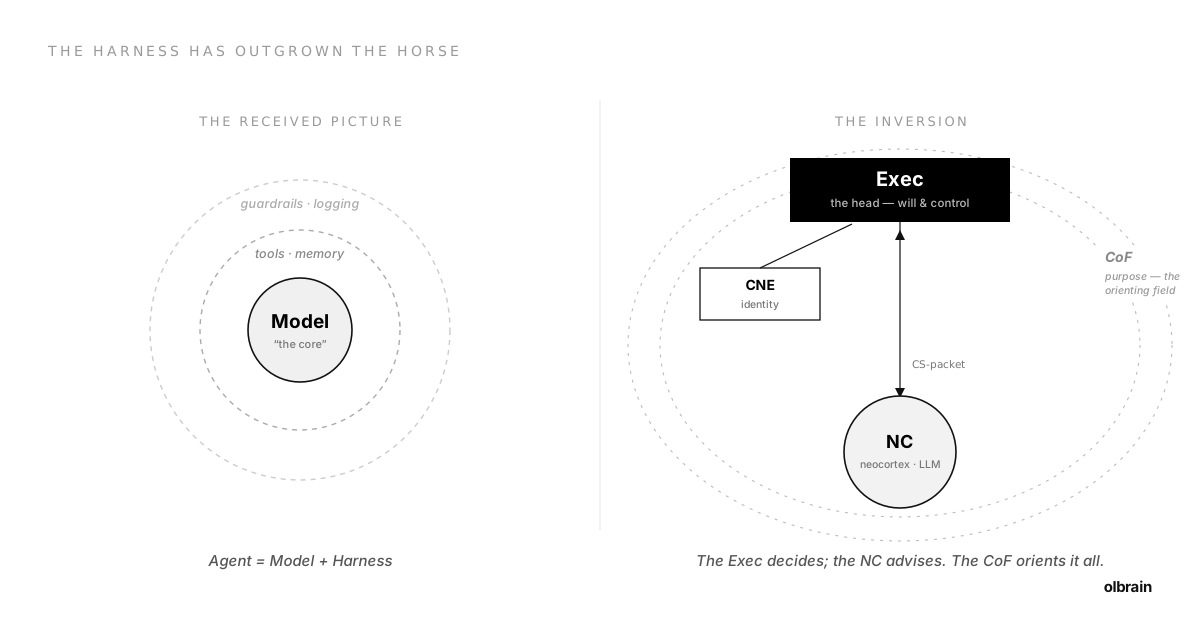
The definition has converged quickly. The most-cited treatment, published on Martin Fowler’s site, puts it plainly: the harness is “everything in an AI agent except the model itself — Agent = Model + Harness.” Its diagram is a set of concentric circles with the model at the center and harness layers wrapped around it. Other treatments are franker about the metaphor: the LLM is the horse — raw strength, useless for farming until a harness directs that power at the plow. Tools, memory, orchestration, guardrails, verification, logging: tack.
It is worth saying immediately what this framing gets right, because it is not a small thing. The harness camp noticed — earlier and more honestly than most — that a raw model does not do useful work, and that the gap between a demo and a dependable system is closed by engineering around the model, not by waiting for a better one. A widely repeated result makes the point: the same model, moved into a better harness, jumped a coding benchmark from rank #30 to rank #5. The engineering is real. The discipline is real.
The problem is the noun.
2. Their Own Evidence Has Outgrown Their Metaphor
Read the harness literature closely and a strange pattern emerges: the findings keep contradicting the picture on the cover.
The model is described as “a pluggable component” — multiple models can share one harness; harnesses “make AI systems model-agnostic.” Entire essays are written arguing that the infrastructure around the LLM matters more than the LLM itself. The horse-and-plow essay concedes, in its own words, that “the model was never the problem” — and then crowns the filesystem, not the model, as the king of agent state.
Hold the metaphor up against those claims. A harness is subordinate by definition: the horse is the prime mover, and you cannot swap the horse and keep the same horse. Yet every practitioner has already accepted the swap. Teams replace one frontier model with another underneath a running agent and say, without hesitation, that it is the same agent — same name, same memory, same obligations, same track record. That sentence is only sayable if the agent’s identity was never in the model. Nobody swaps the animal and keeps the animal. You can, however, swap an organ and keep the self.
So the field has discovered, empirically and piece by piece, that the thing it calls the harness is where persistence, reliability, and identity actually live — and it has kept a vocabulary that says the model is the protagonist. The findings have outgrown the metaphor. What remains is to finish the thought.
3. What a Harness Cannot Carry
Ask what a harness carries for a horse. Not the horse’s memory. Not its drives. Not its continuity from yesterday to today. Not its identity — the horse is the same horse with the tack off. A harness transmits force and direction. Everything that makes the horse a horse is in the horse.
Now ask what the “harness” carries for an LLM-based agent. The goals — the model has none of its own. The memory — the model forgets everything between calls. The continuity — each invocation is a fresh instance with no binding relationship to its own past, a problem we have examined in detail in the coherence essay. The identity — supplied entirely from outside, since the weights are a frozen artifact shared by every copy. The commitments, the constraints, the record of what this agent decided before and why: outside, outside, outside.
In other words: every agency-constituting property of the system lives in the part the field calls tack. The model contributes something enormous — reasoning, abstraction, language, the flexible cognition no one else can build — but it contributes it the way an organ contributes a faculty, not the way an animal owns a harness.
The biological comparison is worth making exactly, because it is the harness camp’s own metaphor turned right-side up. In a human being, the neocortex is the newest and most spectacular structure — the seat of abstraction, planning, and language. It is also not the person. It is recruited, consulted, and overridden by older executive and limbic systems that carry the drives, the homeostasis, the continuity of the organism. No neuroscientist says the body is the cortex’s harness. The cortex is a faculty of the organism. Saying “the LLM is the agent and the rest is harness” is saying “the neocortex is the person and the body is its tack.” It inverts the actual dependency.
4. The Inversion: The Executive Is the Head
Here is the same system described with the dependencies the right way up — the architecture we build at Olbrain, The Machine Brain (TMB):
TMB = Exec ⟳ [ (CoF + CNE + context → CS) ⇆ NC ]
- The Executive (Exec) is the head — the will and control loop. It owns the decision. It reads the agent’s purpose and identity, frames the question, weighs the answer, and commits the action. Nothing executes because a model emitted it; things execute because the Exec decided.
- The CoF (Core Objective Function) is the agent’s declared purpose — the fixed reference that makes “consistent with itself” a checkable property rather than a vibe.
- CNE — the Agency Protocol — is the agent’s identity: Coherence, Narrative Continuity, Exclusivity, jointly constitutive. This is what persists, what binds today’s decision to yesterday’s reasoning, and what an auditor can verify.
- The CS-packet (Cognitive Substrate) is the runtime carrier — the disciplined signal, compiled from purpose, identity, and live context, that travels to the reasoning faculty and back. It is the nerve impulse of the system, not a faculty of its own.
- The NC (neocortex) is the consulted reasoning faculty. Today, LLMs implement it — superbly. The Exec sends the CS-packet to the NC; the NC returns analysis, drafts, judgments. The NC advises; it does not decide.
Notice what this framing makes natural that the harness framing makes awkward. Model upgrades become organ improvements: the agent thinks better and remains itself, the way you remain yourself as your cortex learns. Multi-model setups become what they obviously are — one agent consulting different faculties for different work — rather than the metaphysical puzzle of one harness strapped to several horses. And statelessness stops being a defect to patch and becomes a design fact to architect around: the NC was never supposed to carry the self, any more than your cortex carries your pulse.
This is also why we say Olbrain builds agency, not intelligence. The intelligence — the NC — is the part the frontier labs supply, the part that is commodity precisely because it is swappable. What we build is the part that cannot be swapped without destroying the agent: the head, the purpose, the identity, and the disciplined signal that binds them to the faculty. Identity is the mechanism; agency is the product.
5. Why the Words Matter
If this were only metaphor hygiene, it would not deserve an essay. It matters because the two pictures send engineering — and governance — in different directions.
The harness picture optimizes the wrong layer. If the model is the core, then the road to a better agent is a better model, and the harness is a cost center you minimize. Teams that believe this underinvest in exactly the layer their own benchmarks say is decisive, and wait for the next release to fix what is actually an architecture gap. The rank-#30-to-#5 result was not a model getting smarter; it was an agent getting a better head.
The harness picture has no place to put identity. Read the harness literature again and notice what is missing: the word “identity” barely appears; accountability, almost never. This is not carelessness — it is the metaphor doing its work. Tack does not need an identity. But an agent that owns a regulated workflow does: when a Risk officer asks “why did you decide this today when you decided otherwise in March,” the answer cannot live in a stateless organ that was swapped twice since March. It can only live in a persistent, coherent, exclusive record — an identity — maintained by the part of the system the harness camp declines to name. An agent’s actions must be attributable and independently verifiable, traced to the agent’s identity, so that the enterprise deploying it can discharge its accountability. None of those words attach to a harness.
The harness picture mislocates trust. If the model is the agent, then trusting the agent means trusting the model — a black box, re-tuned quarterly by a third party. If the Exec is the agent, trust attaches to the part that is explicit, inspectable, and owned: the declared purpose, the identity record, the decision discipline. That is a thing a regulator can examine. A horse is not.
6. The Honest Caveat
The strongest objection deserves stating plainly. Frontier labs are working to push memory, persistence, and self-models into the models. If they succeed, some of what we locate in the Exec migrates inward, and the boundary blurs. Anyone claiming this distinction as a permanent moat is overclaiming, and we do not.
But the argument for an explicit, separable head does not rest on the labs failing. It rests on what accountability requires. A self-model entangled in a trillion frozen weights is not auditable; an identity that changes when the vendor ships an update is not continuous; a decision process nobody can inspect does not let anyone discharge accountability for it. Whatever the models absorb, the enterprises that answer to regulators will need the will, the purpose, and the identity of their agents to be explicit, separable, and verifiable — because that is the part they must show to someone else. The architecture that stays correct when the auditor arrives is the one with a head you can point to.
7. Conclusion: Stop Building Tack
The harness engineers are better empiricists than their metaphor allows. They discovered that the model is pluggable. They discovered that the infrastructure decides whether the agent works. They discovered that state, not weights, is king. Every one of those discoveries is a fact about where the agent actually lives — and the word “harness” keeps filing those facts under accessories.
A harness carries no memory, no purpose, no continuity, no self. The systems being built under that name carry all four. They are not harnesses. They are organisms with one magnificent borrowed organ — and the teams that realize this first will stop polishing tack and start building heads: an Executive that decides, a purpose that orients, an identity that persists and can be verified, and a neocortex — consulted, brilliant, replaceable — that advises.
The horse was never the rider. The model was never the agent.