Building Agency the Good Old Neurosymbolic Way
LLMs are the most significant invention of our time.
That’s not hyperbole. In the span of a few years, we went from machines that could barely string sentences together to machines that reason, create, debate, code, and understand nuance across dozens of languages. The jump in capability is unlike anything in the history of computing — perhaps in the history of human invention.
And here’s what makes it even more extraordinary: LLMs gave AI something remarkably close to what the neocortex gives humans.
The Neocortex Moment
The neocortex is the outermost layer of the human brain. It handles language, abstract reasoning, planning, creativity — everything we think of as “higher thought.” It’s what separates human cognition from everything else in the animal kingdom.
LLMs are the neocortex of AI. They gave machines the ability to think abstractly, understand context, reason through complex problems, and communicate naturally. This is a monumental achievement. The foundation for everything that comes next.
But here’s something worth thinking about: humans don’t run on the neocortex alone.
Underneath it sit older, deeper structures — the limbic system, the hippocampus, the brainstem. These handle things the neocortex doesn’t: persistent memory, emotional continuity, self-preservation, the sense of being a consistent self across time. They’re less glamorous than the neocortex. Less talked about. But without them, you don’t have a functioning person. You have raw intelligence with no self.
A human with only a neocortex would be brilliant but formless — capable of extraordinary thought in any given moment, but unable to carry a persistent identity, maintain consistent beliefs, or be the same person tomorrow that they are today.
Sound familiar?
AI Agents Today: All Neocortex, No Self
That’s precisely where AI agents sit right now. Thanks to LLMs, they have an extraordinary neocortex. They can reason, understand, and respond with a sophistication that would have been unimaginable five years ago.
But they have no deeper structure. No persistent self that carries forward. No mechanism ensuring that today’s beliefs are consistent with yesterday’s commitments. No system maintaining that this agent is a singular, continuous entity over time.
They’re all neocortex and no limbic system. Brilliant in the moment, formless across time.
This isn’t a criticism of LLMs — the neocortex is magnificent, and so are LLMs. It’s simply an observation that the neocortex was never designed to do everything. In humans, it works in concert with deeper structures. In AI, those deeper structures haven’t been built yet.
That’s where neurosymbolic AI comes in.
The Neurosymbolic Approach
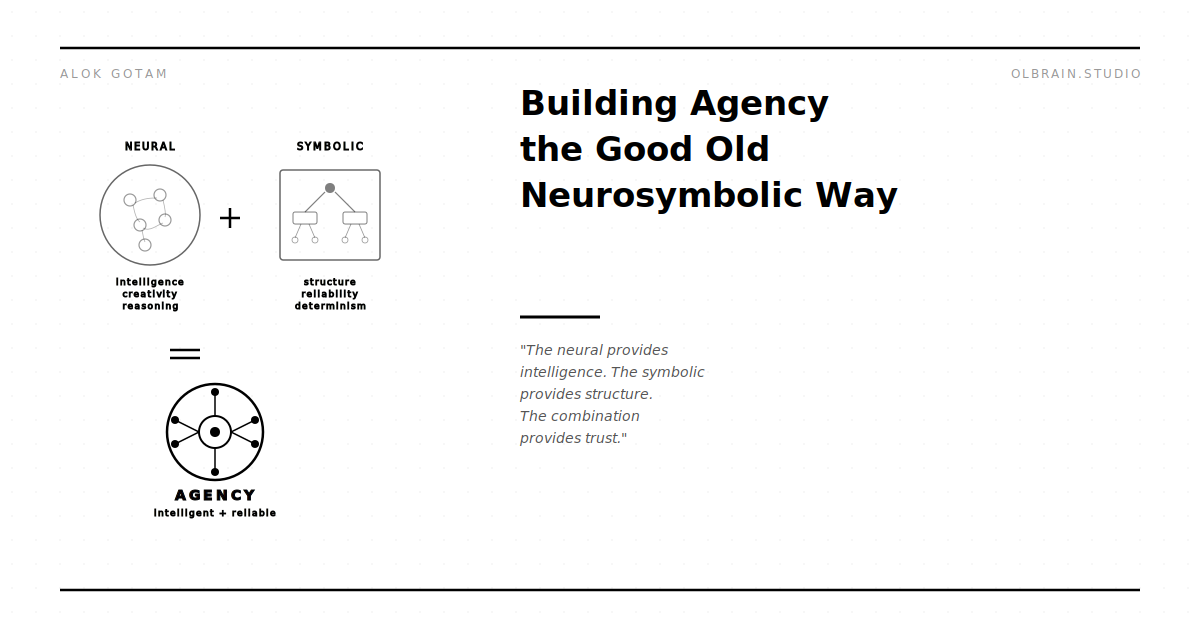
Neurosymbolic AI is the idea that the best AI systems combine neural networks (which are brilliant at pattern recognition, language, and creativity) with symbolic systems (which are brilliant at structured reasoning, verification, and deterministic logic).
This isn’t a new idea. Researchers like Gary Marcus and others have advocated for it for decades. And the evidence is piling up — every production AI system that achieves real reliability, from protein folding to mathematical proofs, uses some form of neurosymbolic architecture.
The application to agency is natural:
The neural layer (the neocortex): LLMs provide reasoning, language understanding, creativity, and conversational ability. This is the magnificent foundation. It’s what makes the agent intelligent, adaptive, and capable of natural interaction. It handles ambiguity, nuance, and the messy complexity of real conversations beautifully.
The symbolic layer (the deeper structures): Deterministic, structured systems that provide what the neural layer was never designed to handle:
Coherence — a formal mechanism that tracks an agent’s beliefs and verifies that every update is internally consistent. When the agent learns something new or makes a commitment, the system ensures it doesn’t contradict existing beliefs. Not probabilistically. Provably.
Continuity — a structured world model that serves as the agent’s persistent self. Not a chat log for the LLM to reference. A formal, evolving representation of who this agent is — what it knows, what it’s committed to, how it understands the world. This model persists across every conversation, every channel, every month. It’s the hippocampus of the agent — the seat of long-term identity.
Exclusivity — a tamper-evident system ensuring exactly one live instance of any agent identity exists at any time. Cryptographic verification. Deterministic logic. One agent, one identity, provably. This is the self-preservation instinct — the mechanism that prevents an identity from being cloned, forked, or impersonated.
The neural layer gives the agent a magnificent mind. The symbolic layer gives it a self. Together, they create holistic agency — an agent that is both intelligent AND persistent, both creative AND accountable, both adaptive AND consistent.
Why This Matters
Consider how humans build trust. You trust your doctor not just because they’re smart (neocortex) but because they remember your history, maintain consistent advice, and are verifiably the same doctor you saw last time (deeper structures). Remove either layer and trust collapses.
The same applies to AI agents. Intelligence alone doesn’t create trust. An agent that’s brilliant in conversation but contradicts itself across sessions, forgets customer history, or can’t be verified as a singular entity — that agent might impress in a demo but it can’t sustain a real relationship.
Holistic agency — the combination of neural intelligence and symbolic identity — is what allows an agent to move from “impressive tool” to “trusted entity.” From transaction to relationship. From one-off interaction to ongoing partnership.
The Road Ahead
LLMs gave us the neocortex. The most extraordinary gift to AI in its history. The foundation on which everything is being built.
The next step is completing the picture — adding the deeper structures that turn raw intelligence into a coherent, persistent, accountable self. The neurosymbolic approach. The good old way that turns out to be the way forward.
The neocortex was never the whole brain. It was always the beginning of one.